
Catching Life’s Currents/Guidepost Fourteen: The Power of Indirect Effort
(Paid Subscribers Only) You’re Not Stuck—You’re Just Pushing in the Wrong Place
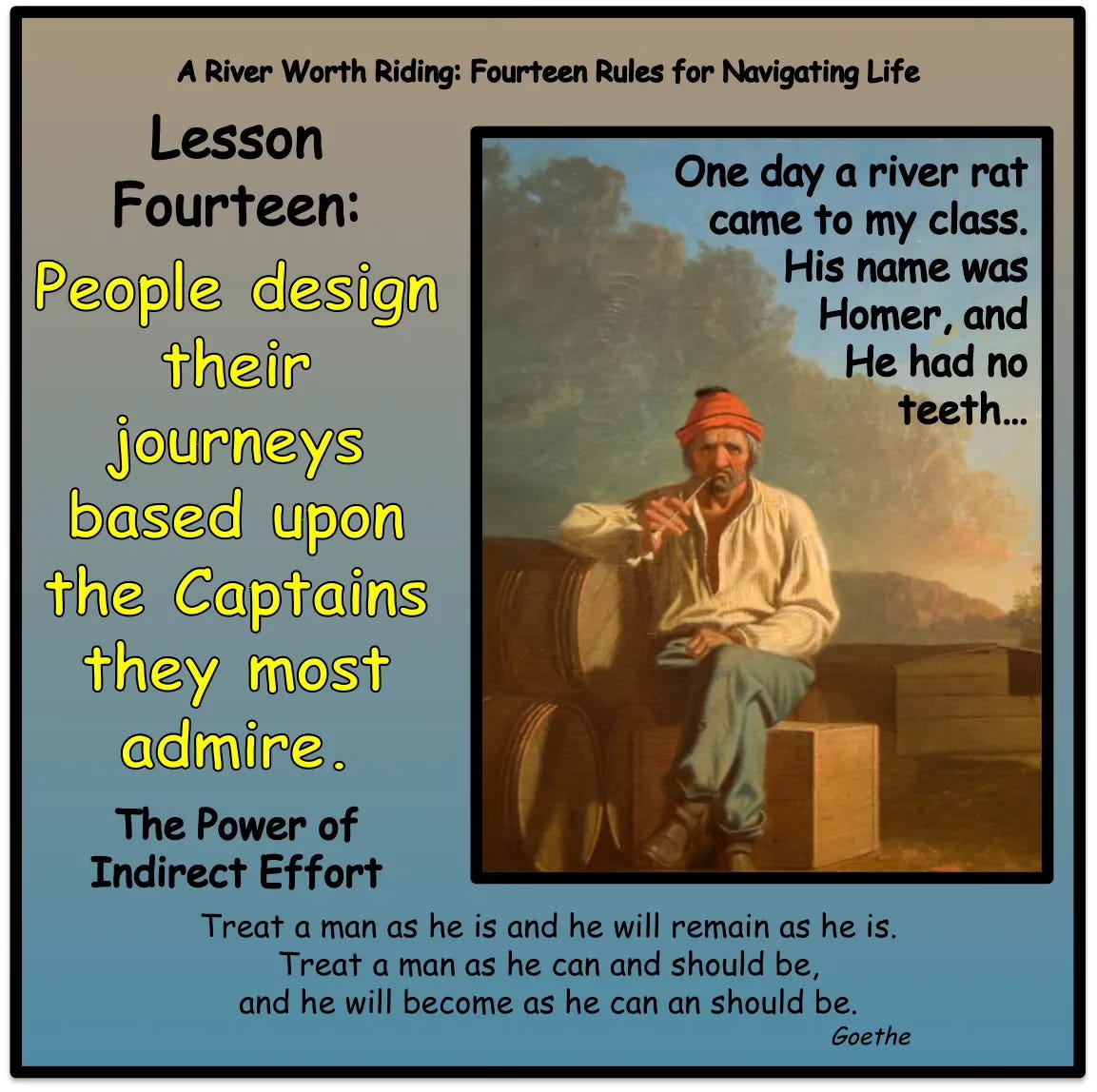
In this final lesson, we explore the power of Indirect Effort — the quiet force behind the most lasting changes in our lives and relationships. We'll discover what a fulcrum is, why finding the right one matters far more than applying more force, and how five common fulcrums operate in human systems every day. Along the way, we'll meet a river rat named Homer, a woman named Dulcinea, and a wise man named Don Quixote — and we'll learn why context may be the most transformative gift we can offer another human being.
The other day, I heard something that made me laugh out loud—one of those loud, soda‑out‑your‑nose guffaws. I’m not quite sure if you’ll get the joke, but here goes…
According to several news sources, Saudi Arabia was all for America and Israel “taking out Iran” when they dropped their first bombs on February 28, 2026. I’ve heard that Mohammed bin Salman, along with Benjamin Netanyahu, were actually egging Trump on. “Don’t worry, we’ll be in and out of there—just like Venezuela.”
I suppose it’s understandable. Many people are more than unhappy with the Iranian regime; and Saudi Arabia knew that if oil prices rose, it would only benefit their coffers. And in fact, those costs have increased—within less than a month they are hovering around $100 per barrel—and because I live in Hawaii, when I next fill my gas tank, I will be paying over $5 a gallon.
So what was so funny that I actually soda-snorted out loud?
Well apparently, as of this writing, Saudi Arabia is getting worried that the oil prices might go as high as $200 per barrel, making the price so prohibitive that people would be forced to change their habits, perhaps long-term, and seek alternative energy sources. The long term and indirect effect of all of this effort? The demand for their black liquid gold would diminish and their over-stuffed coffers would eventually dry up. They even have terms for what they’re afraid of—Market Recalibration and Behavioral Adaptation!
Such is the irony of Indirect Effort.
You see, while all effort produces effects, not all effects are produced by direct effort. In fact, the most powerful and long lasting changes often occur indirectly through the systems our actions influence—often creating outcomes we don’t intend and can’t control. We ignore Indirect Effort’s effects at our peril.
However, if you can learn to spot the leverage and fulcrum points within a system, you can also learn to avoid getting hit by any indirect backsplash.
Still not sure what I’m talking about? Well, let’s take liars as another example. Every kid tries to lie their way out of trouble… at least the first few times. Then one day, they get smacked in the face with the indirect effect of lying—people start automatically disbelieving you, even when you speak the truth. Or, as Aesop put it:
“οὐδὲ τὰ ἀληθῆ λέγων εἰσακούσθῃ.”
“… One (who lies) will not be believed, even when speaking the truth.”
— from the moral of Ποιμὴν παίζων (The Shepherd Playing) Aesop’s Fables, Perry Index 210
Once you know what Indirect Effort looks like, you’ll begin to see its ripples everywhere. In the poor overwhelmed friend who never learned to say “no.” In the lonely bully who simply can’t understand why nobody likes him. Or what about this next fun fellow? I wonder if you will recognize him:
There once was a mother with an incorrigible son who craved the attention of everyone. “Look at me! Look at me!” he would yell toward the banks, jumping up and down so hard that the boat would rock and breakfast would fall to the deck.
His nanny would sigh and clean up.
At school, the boy who craved attention struggled because he could make no sense of all the letters and squiggles, so he found other ways to get noticed. Several times each week he came home with his clothes torn and dirty from the fights he’d start in order to prove himself.
His father would sigh and clean up.
His first love was fleeting… all focused on him. His first job a failure… too boring for him. His sixth company went the way of his businesses one through five… each with more money going out than coming in.
His workers would sigh and clean up.
Then one day he looked around and found himself alone — and he looked to the river for cleaning. But the river flowed past the wreckage in his wake, offering nary a word.
Until a stranger came by with a plan, “I will trade your mess for mine, and I will throw in some glitz with which you can hide it.” Another came by a few weeks later… his offer just the same. And so it went on for years—each small mess traded for a larger mess, the pile of glitz glinting higher, until the youth was a youth no longer.
If you look for him, you will see him still—stranded and clinging to the rails of his gold leaf deck. “Look at me! Look at my gold! Look at me!” he will cry. But the people on the bank can only see the absolute mess no amount of gold can hide.
And so they sigh and clean up.
Psychologists call the phenomenon ‘learned helplessness.’ Imagine a world where you have never been asked to drive for yourself, or cook for yourself, or clean up your own mess. Imagine a world where your mistakes are wiped clean, no accountabilities are required, and boundaries are never enforced. What kind of person might indirectly emerge from that world?
Indirect Effort leaves its fingerprints everywhere — and the navigator who can spot its fulcrum will always have a smoother ride.
In this lesson, we will:
Explore how Indirect Effort leaves its fingerprints on everything — from geopolitics to your kitchen floor
Understand what a fulcrum is, and why finding one matters more than applying force
Meet five of the most common human fulcrums — the State of the Listener, Identity, Natural Momentum, Context, and Norms
Discover why behavior is almost never the fulcrum — and what actually is
Explore how context creates compassion indirectly — and why compassion may be the most powerful fulcrum of all
This lesson is part of a larger learning experience, Catching Life’s Currents: A 14-Week Guidepost Journey, offered to paid subscribers, as well as individual and group clients. If you would like to learn more, click here.
Keep reading with a 7-day free trial
Subscribe to Navigating a Whackadoodle World to keep reading this post and get 7 days of free access to the full post archives.