
Catching Life’s Currents/Guidepost Eight: The Power of Responsibility
(Paid Subscribers Only) In this lesson, we will dive into the art of personal responsibility—spot limiting thoughts, explore your choices, and practice acting with intention.

In this lesson, we explore the heart of Personal Responsibility—how to recognize where our attention and energy truly matter, distinguish between what we can influence versus what we cannot, and make choices that reflect our values rather than reacting to circumstance. Through stories, reflections, and practical exercises, you’ll learn to spot limiting thoughts in yourself and others, shift from wishful to productive thinking, and strengthen your ability to act intentionally. By the end, you’ll understand not just the theory of responsibility, but how to apply it in daily life, from small habits to meaningful promises.
As you’ve probably noticed, I like to begin each lesson with a story…
For about a year now, my dad and I head to the local District Park pool three times a week to take advantage of their short course lap swims. “What’s a short course lap swim,” you ask?
Well, regular lap swims use the length of the pool as the lap. Short course laps are where you swim the width of the pool, and that’s the lap—much easier laps for a 96-year-old man and his 64-year-old daughter. Not that my dad isn’t fit. For 96, he’s doing pretty well, but he does have balance issues which make regular exercise difficult. The beauty of lap swimming is that if he loses his balance, the water is there to catch him.
We have a whole routine set up. Shortly after noon, I start packing the bag to take with us: two large fluffy beach towels, snorkel set, face mask, flask of ice water for dad, travel cup of cola for me, various sundries, sunglasses. You get the idea. My dad takes his pre-shower at home—where the water is warm and he has a shower stool to sit on. I help him with his special socks—I won’t let him near the pool without foot protection, because without it, he’s sure to scrape a toe.
We try to arrive at the pool around 2:30, before the after-school crowd drops by. I go ahead a little, while dad takes his time with the walker. My first goal is to claim two lines next to each other—otherwise I end up sharing his line, and things get tight.
I suppose I should explain what I mean by claiming a line.
You know how pools are divided on the bottom with lines to set up the lanes for swim competitions? Well, in short course lap swimming, individuals each claim a line to swim on, so nobody bumps into each other. I need two of these lines together because I’m just enough of a hoverer that I always want to swim next to my dad.
Anyway, our routine has become pretty set. Say hello to all the friends we’ve made, then Howard, the head lifeguard, helps my dad into the pool. I double-check his ears to make sure the hearing aids are not about to join us in the water. (We lost a set last year when all three of us forgot to check—Howard, dad, and I.) We aim for ten, maybe even twelve laps, but if it’s too cold, we’re happy with eight.
All in all, it’s been a great habit to build into our lives, and I recommend it highly.
So last October, I had a friend visiting for a week—celebrating my birthday among other things—and she joined us at the pool most days. I still remember how on that first day, she took one look at the pool and commented, “They’re all swimming wrong.”
“Huh?” I had to ask. She’d been a lifeguard herself when younger, so I figured she might know something I didn’t.
“Look,” she pointed at the swimmers. “None of them are swimming in the lanes.”
“Oh, that,” I sort of laughed. “No, here we swim on the lines.”
“But then you have one less spot,” she insisted, “The pool has sixteen lanes, but only fifteen lines.” She shook her head, frowning.
“Never really thought about it,” I shrugged, then set about sorting our belongings on their various lines. My dad’s face mask, snorkel, and water on his line. My cola and slippers on mine. Both towels set out on the walker for fast retrieval when we were done.
My friend didn’t pick a line, deciding the lane between our lines would do for her—after all, she was there more to hang out with friends than to swim laps. The swimming was a little tight, but what’s a little water kicked in the face among friends? By and large, we had a really nice time, and I hadn’t really thought about it again—until this week.
The swim began like so many others. I was doing a slow breaststroke behind dad, my head as always out of the water—partly because my ears are prone to infection when watered, but mostly because I like to keep one eye peeled on dad. And this time, I kept getting water in the face whenever the lady next to me swam by. It took me a couple of passes before I realized that she was swimming in the lane, not on the line, hence my water-filled face.
I suddenly had a flashback to my friend. She’d really been bugged by the whole line versus lane thing. She’d actually brought it up several times during our visit. And I swear, at one point, I thought she wanted to go up to Howard and tell him what the pool was doing wrong. She’d been a lifeguard, a swim instructor, even on the swim team. She knew where we were supposed to be swimming and it really bothered her that we were doing it wrong. I wondered if the lady next to me felt the same.
And then, as I am wont to do, I began to wonder about what it might say about a person that comes into someone else’s house and immediately finds fault with its house rules. Like when I was traveling with the Department of Defense, and my fellow travelers would complain that things weren’t like they were at home.
More than that, what does it say about a person that they completely disregard the house rules, or simply insist on playing by their own? Did she even notice the norm she was breaking? Did she even notice how it affected the people around her? Did she ever consider how her actions might influence how people responded to her?
I somehow doubted it as the water continued to hit my eyes.
Of course, I didn’t say anything, or offer her any glares. After the first few full-face splashes, I simply edged off my line and closer to my dad’s, allowing her the space she required. But while I swam, I started to reflect on the impact of simple choices—her choice to swim lanes and my choice to move over. What did her choices say about the world she lived in? What did my reactions say about mine?
Same pool, different worlds.
But I still gotta say, I think it’s bad form to come into someone else’s world and completely ignore the rules of that world. Perhaps that’s just me.
And as I was swimming through my mundane world, suddenly a wider thought surfaced—splashed with sunlight. Our lives are the quiet sum of our choices, and I was challenged to choose mine responsibly.
So how does someone choose Responsibility?
Well, to be honest, a lot of people don’t:
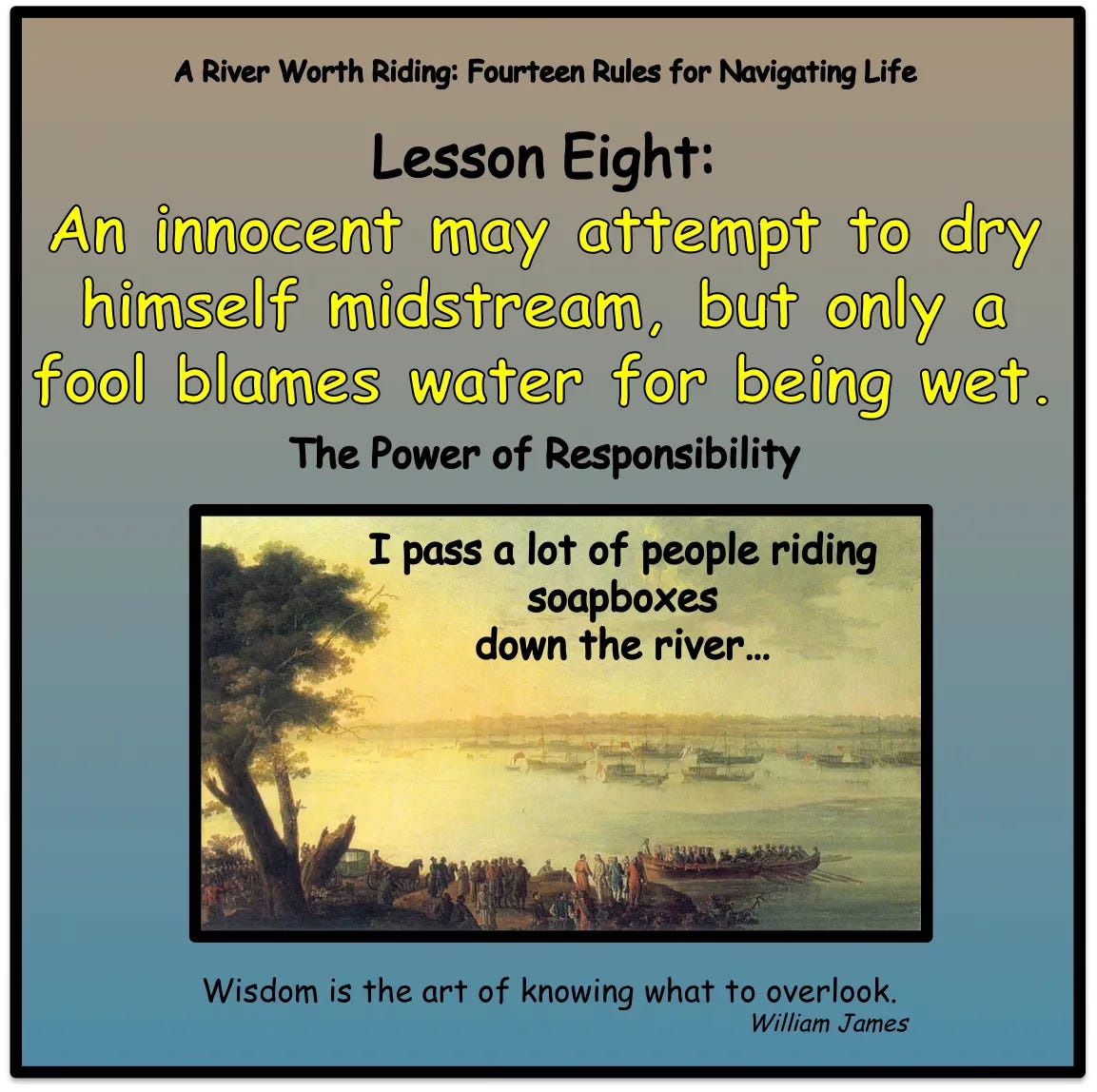
I pass a lot of people riding soapboxes down the river. Do you know about soapboxes? They’re the boxes people stand on to get your attention so they can tell you everything they think you ought to know.
One soapbox rider I passed felt it was his duty to point out every terror on the river, so I wouldn’t be afraid of the unexpected, I guess. Another soapbox rider kept pointing out what I was doing wrong, so I could fix myself up, no doubt. Still, another soapbox rider kept shouting about how nobody was doing anything at all about the problems on the river. Judging by him, I guess he was right.
Soapbox riders are easy to spot. They hang around the shallows using language like: I can’t… You should… If only… I had no choice… I’ve tried everything… He started it… I wish… Do something!
Soapbox riders often claim that the river is an uncaring place because the river doesn’t seem to care about everything they think they know.
I like to spot soapbox riders as soon as possible so I can give them a wide berth. I don’t like how they waste my time with nonsense. Besides, I can’t really see why anyone would want to ride a soapbox. They make terrible boats. I mean, you can’t accomplish much standing on a stupid lid talking to people who don’t need or want your advice.
Oh sure, soapbox riders are great at spotting problems and defending points of view, but the river needs more people who can discover solutions and embrace new points of view. I think the most annoying thing about soapbox riders is that even when they do make good points, they never use those points to get anything done.
I’ve yet to see a soapbox rider accomplish anything worthwhile on the river.
In this lesson, we will:
Explore what Personal Responsibility actually means — and what it does not mean
Learn to recognize where our attention goes, and why that matters
Map the difference between Circumstance, Concern, Influence, and Control
Notice the real cost of living reactively, without moralizing it
Distinguish between proactive and reactive ways of thinking and behaving
Examine how habits of thought are learned — and therefore changeable
Understand why responsibility is often resisted, even when it’s empowering
Practice tools for shifting responses without fixing, blaming, or controlling
Begin strengthening our ability to choose responses aligned with our values
This lesson is part of a larger learning experience, Catching Life’s Currents: A 14-Week Guideposts Journey, offered to paid subscribers, one-on-one learners, and groups. If you would like to learn more, click here.
Keep reading with a 7-day free trial
Subscribe to Navigating a Whackadoodle World to keep reading this post and get 7 days of free access to the full post archives.