
Catching Life’s Currents/Guidepost Three: The Power of Reflection
(Paid Subscribers Only) Examine how Reflection can help us improve our understanding—of both ourselves and others—minimize conflict, and avoid that ingrained reflex to take things personally.

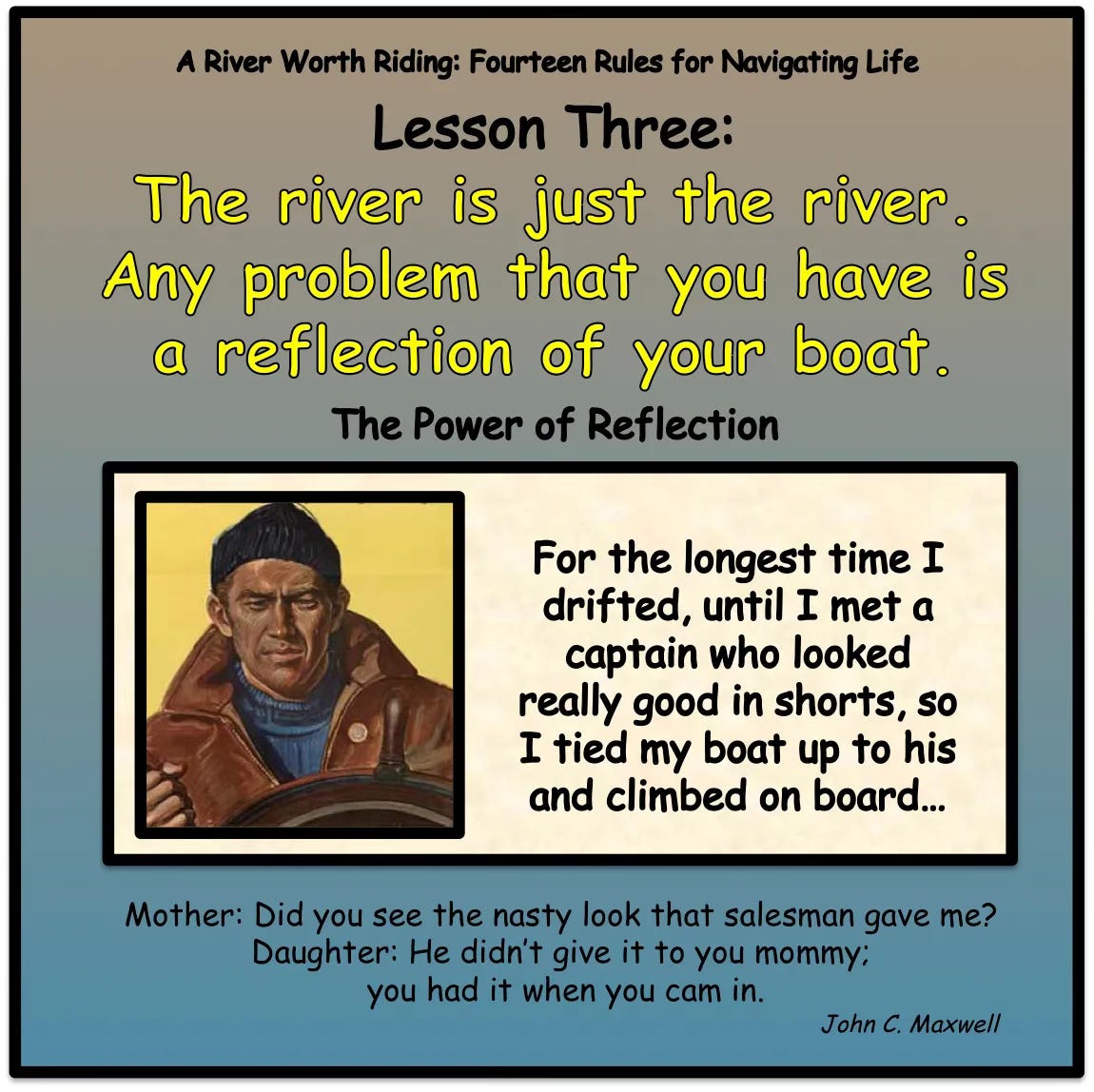
Life is full of assumptions, misunderstandings, and reactions that leave us frustrated or stuck. This lesson gives you a simple game-changing tool: Reflection. By noticing what people’s words and actions reveal about their beliefs—and by looking at your own—you can stop reacting to assumptions, see the world more clearly, and make choices that actually serve you. It’s not about fixing yourself or others; it’s about understanding, clarity, and freedom—and the more you practice, the more it reshapes how you move through life.
Why Practicing Reflection Is Powerful
Something intriguing happened as I was preparing this curriculum. Let me preface the story by mentioning that I have been using artificial intelligence quite a lot recently—mostly because I have dysgraphia and can never spot my own typos, but also occasionally to do some brainstorming. So as I often do, I opened a ChatGPT chat box and wrote, “I need to work on Lesson Three’s curriculum for my Catching Life’s Currents Online Course. Do you remember what the curricula is like, or should I show you last week’s lesson as a sample?”
The chat box asked to see a sample, so I pasted one in. The chatbot said thank you and poured out a precise breakdown of our last week’s lesson, along with what it called, “A suggested skeleton outline for the Guidepost Three curriculum.” And I have to say… it looked gorgeous. A full lesson on the Power of Reflection miraculously appearing before me within seconds. My work was done, right?
But here’s the problem—and the irony. The outline was full of assumptions about what Guidepost Three really teaches. One of the main things I teach in Guidepost three is the danger of making assumptions. The irony hit me immediately. The people programming these AIs actually program them to make assumptions in order to make them seem more human.
In fact, there is a name for what they do — it's called ‘next token prediction,’ and it’s embedded in its design. Rather than truly understanding a question, these systems simply predict what word or phrase is most likely to come next, based on patterns they've seen before. They don't actually understand the lesson. They are merely predicting what the lesson should look like.
Think about that for a moment.
Making assumptions—a human flaw—is so ingrained in human nature that AI programmers are actually programming their creations to make assumptions in order to make them seem more human. Wild!
And make no mistake, our instinct to make assumptions is a human flaw.
Now don’t get me wrong, assumptions are not inherently bad. If I see a bear while I’m out hiking, I’m going to assume that bear is hungry. If I touch a hot oven, I’m going to assume I’ll get burned. When the sun goes down each night, I assume it will come up in the morning, and so I plan my life accordingly.
However, assuming that you meant to get me mad when I got mad? That? Well, that can get you into trouble.
Our ability to assume and react both quickly and appropriately to our assumptions is an important instinct—essential to our survival. However, assumptions are also one of the main reasons why our interactions with others become full of misunderstandings, confusion, and disruption.
Reflection teaches us to pause before we react to ensure that we’re reacting to what is true rather than to just another assumption.
In this lesson, we will:
Examine how people’s perspectives, worldviews, and belief systems show up in their words and actions
Discover how these words and actions can provide clues to their worldviews and aid our understanding
Recognize that what people say about the world and others reveals more about them than it does about anyone else—including you
Learn and practice a tool for strengthening our reflective abilities
Use this same tool to examine our own belief systems and identify any limitations we might be imposing on ourselves
By the end of this lesson, you’ll have a reflective framework that helps you understand others’ perspectives, see what their words and actions reveal about their worldviews, and uncover hidden limitations in your own beliefs.
This lesson is only available to paid subscribers, one-on-one learners, and groups taking Catching Life’s Currents: A 14-Week Guideposts Journey. If you would like to learn more, click here.
Keep reading with a 7-day free trial
Subscribe to Navigating a Whackadoodle World to keep reading this post and get 7 days of free access to the full post archives.