
Catching Life’s Currents/Guidepost Four: The Power of Focus and Attention
(Paid Subscribers Only) Examine how both your Focus and Attention are not just ways to get things done — they shape your life, your perspective, and your joy.

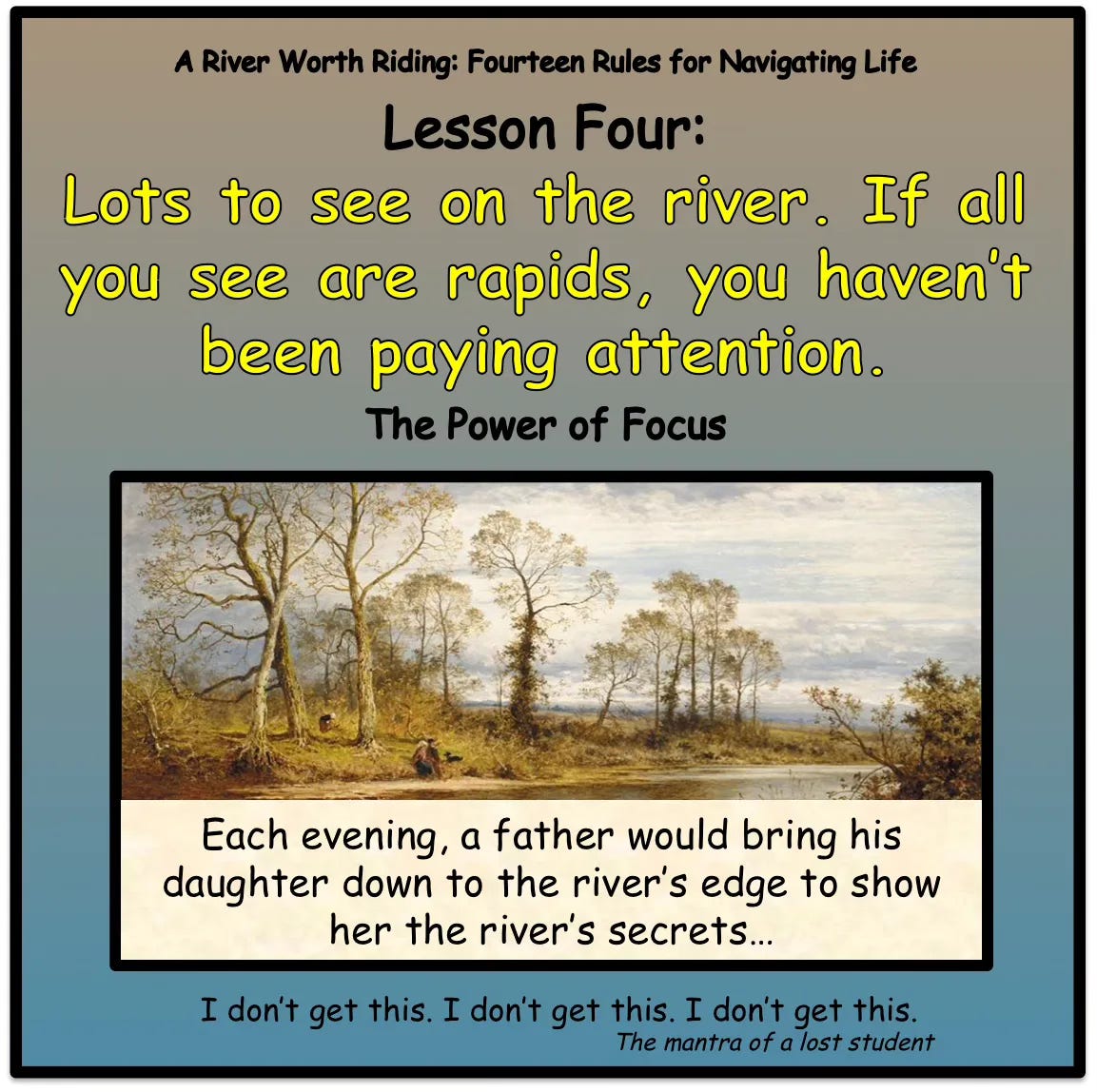
Focus is not just about paying attention—it’s about shaping your experience, your emotions, and even your reality. Where your mind goes, your life follows. In this lesson, we’ll explore how to harness attention not as a fleeting tool, but as a deliberate practice that empowers you to see more, feel more, and live more fully.
Why Attention and Focus are so Powerful…
Have you ever had this experience? You’re in a room, doing dishes or scrolling through emails, maybe even at a small gathering with conversation buzzing all around, when suddenly you hear someone say your name. Instantly, your focus shifts, you’re all ears, straining to catch every word. And it doesn’t even have to be your name—it could just sound like it. They could be talking about tin mining, but you’re focused on what they were saying about Lynn whining.
Now, consider what this curious behavior, which we all share, says about our focus and our attention? What does it say about us?
That our focus is easily distracted?
That our attention is selective?
That our brain tends to prioritize what it considers personally relevant, while minimizing other things?
Here’s another thing about focus. It has a way of burning things into our memories. I will always remember, with exacting detail, this one time when I was second-hand shopping with my Mom. Now, my Mom loved “second-handing,” and over my lifetime, we must have gone to thousands of second-hand stores. My memories of them remain sort of clumped together in my mind under the file: Things we loved to do together. All that is, except this one time.
I don’t remember exactly which store it was, but I can still picture her across the room from me, thumbing through the many racks of clothing, scanning for any particularly high-quality fabric to catch her eye. I had just found something I thought might appeal to her, so I looked up and called, “Mom.”
Several heads looked up at me, reassured themselves that I wasn’t calling them, and went back to what they were doing. But not my Mom—she was too engrossed. So I called again, slightly louder: “Mom.” The other mothers’ heads popped up again, along with a few more. This time they looked from me to where I was calling. A few of them had discreet grins twitching at the corner of their lips.
My mother was still engrossed in her fabric, so I called a third time, even louder: “Mom.” Again, no answer. By this time, there were probably ten mothers all looking toward my mom, all grinning in recognition, waiting to see what would happen next. Finally, in desperation, I called out in my trained stage voice, “Mrs. Sager,” at which point my mom finally looked up—and all the mothers burst out laughing.
My mother got terribly upset. For some reason, I could never get her to see the humor like the rest of us. Perhaps because she’d only witnessed being part of the punchline.
And what does this story show us about our focus and our attention?
That when we’re engaged in something of interest, our focus becomes more rigorous?
That where we place our attention will affect our memory?
That outcomes and interpretations can be influenced by our focus?
I’ve noticed another weird thing about focus: how it can distort time, influence emotion, and even affect our health.
I lost my Mom in 2020, and it’s been a long time since those shopping trips, but every time I see a second-hand store, my mind instantly goes back. And when I go into one? Time slows down, my heart swells up, and I smile. I notice what my Mom would’ve noticed. I scour like my Mom scoured. I lose myself in memory and feel calm again. I seldom buy. Like my Mom before me, I’m not there for the bargain. I’m hunting for treasure.
And now, I ask again, what is it about this strange quirk of the mind that makes focus and attention so powerful? The great philosopher, lecturer, and writer William James provides one of my favorite answers:
“The greatest discovery of my generation is that a human being can alter his life by altering his attitudes of mind.” — William James, The Varieties of Religious Experience, 1902, Lecture VI: “The Conception of God”
In this lesson, we will:
Demonstrate how one can change one’s attitude by simply and consciously switching one’s focus.
Explore the different forms our focus can take, from laser, to lightbulb, to daylight’s epiphany.
Discuss methods to both tame and free our focus to do its best work.
By the end of this lesson, you’ll have gained an appreciation of the power of your own focus, recognized the limits and potentials of the varying forms of focus, and begun to build a toolkit for allowing your focus to thrive.
This lesson is part of a larger learning experience, Catching Life’s Currents: A 14-Week Guideposts Journey, offered to paid subscribers, one-on-one learners, and groups. If you would like to learn more, click here.
