
Catching Life’s Currents/Guidepost Thirteen: The Power of Persuasion and Influence
(Paid Subscribers Only) Explore practical strategies for influencing others through questions, options, and understanding, plus real-life examples and exercises to practice persuasion effectively.
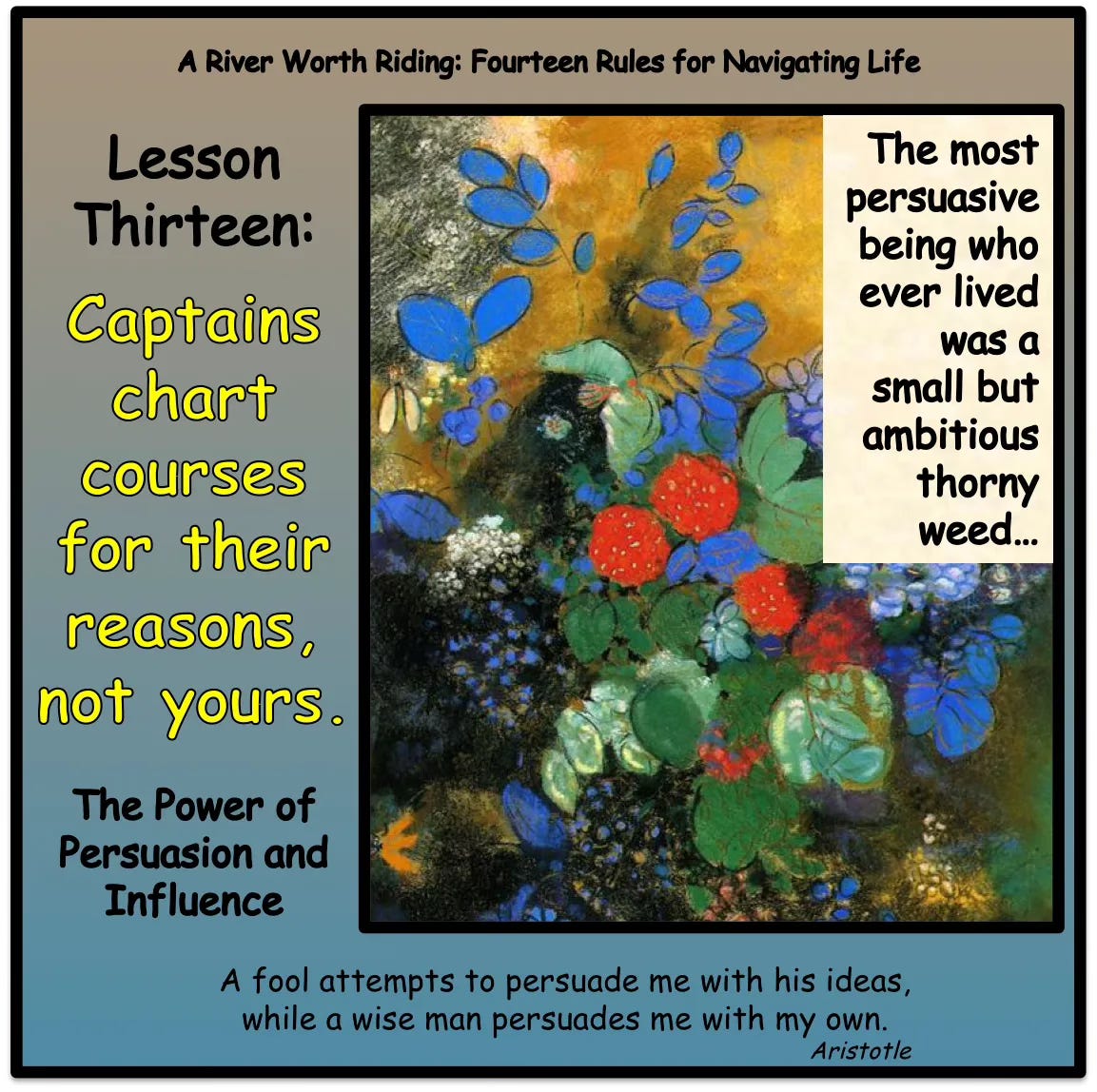
Most of us were never taught how persuasion really works. We were taught to argue harder, explain better, or repeat ourselves louder — and then we wonder why people dig in instead of opening up. In this lesson, we’ll slow down and look at what actually motivates human behavior, why certain approaches damage trust, and how influence can be practiced ethically and effectively. Along the way, you’ll encounter practical tools you can use immediately — from asking questions that open minds, to identifying motivations, to aligning your ideas with what others truly value. The goal isn’t to help you control outcomes — it’s to help you understand people well enough that your ideas get a fair hearing.
Once again, we begin with a story…
The most persuasive being that ever lived was a small, but ambitious, prickly weed. She lived in the crook of a rock near a bend in the river, and she wanted more for herself than a mere weed's life. She wanted more for her children than a mere weed’s existence. She wanted love, and respect, and to be welcomed by all—even to the farthest reaches of the river. She wanted her children to travel, to learn, and to be accepted where no prickly weed had ever been accepted before. But she was only one small prickly weed and she had no words. How would she ever find a better life for her children? How could she ever make a better life for herself?
She seldom had company on her thorny ledge, but she often saw birds flying overhead. “If only my children could hop a ride with the birds,” thought the prickly weed one day. “Then they might travel the river.”
“How can I make the birds notice and hear me?” she asked herself. “How can I make them want to carry my children beyond the river and my ledge?” She puzzled about her dilemma for some time. When suddenly one morning, an inspiration struck her small prickly mind. “What can a prickly weed do better than anyone?” she thought. “We gather sun with our leaves, nutrients and water with our roots, and we turn them into the sweetest of sugars. I shall store up enough sugar to surround my children with a bubble of irresistible juice, so the birds will not be able to ignore them.”
She drank in sun, nutrients, and water for days. Using what she had gathered, she created a berry of such amazing sweetness and color to surround her children that the birds immediately began noticing and craving them. The birds soon flocked to her children, fought over them, and volunteered willingly to fly them anywhere for a mere taste of their sweetness. Her children are now welcomed at every port along the river. People even pay money for the honor of planting her children. This prickly weed is no longer called a weed, and she is currently admired by all. She is now only known by the name of her children's cradle—Raspberry.
But she is still a prickly weed, after all.
Why do trees create fruit? To persuade others to carry their seeds to new lands. Have you bought any fruit this week? If you did, then you paid good money for the privilege of doing for that plant exactly what that plant wants you to do. We could learn a lot from plants regarding the nature of persuasion and influence.
We waste so much energy telling people what to do for our reasons. The trick of persuasion lies in getting people to do things for their own reasons. You may not like worms, but you have to bait your hook with them if worms are what the fish are eating.
Guidepost Thirteen: The Power of Persuasion and Influence simply reminds us that we cannot move anyone with our reasons, so we had better try moving them with their own. The sooner you recognize this subtlety, the happier your relationships will be.
Most people only know a few methods of persuasion, and they practice just one or two of them actively. Even more sadly, the most commonly employed persuasive techniques usually do more harm than good. Here is a list of the ten most popular—and disastrous—persuasive techniques. Let's see how many of these methods are currently in your bag of tricks:
Criticizing—Do you actually think that by pointing out what people are doing wrong, you'll make them want to do your version of right? You will more likely get defensiveness, not cooperation, if you practice this form of persuasion.
Complaining—Complaining is another form of criticism, made worse by its constant repetition. Complainers continue to point out what others are doing wrong in an attempt to make people see things their way, and do things for them. Eventually, people turn a deaf ear to complainers, who tend to expect others to change without bothering to change themselves.
Condemning—What is your reaction to another person’s censure, or condemnation? Defensiveness and martyrdom are the usual reactions. In one, people react with defensive explanations and try to justify their actions. In the other, people accept the title of sinner and decide that they might as well live up to your expectations. In either case, persuasion is unlikely.
Advising—Offering advice when advice has not been specifically asked for creates frustration and animosity between people. The dreaded words, “Well if I were you, I would…”, will more likely cause eyes to roll than hearts to open. Remember, you are not me. You do not know everything about me. So you do not need to offer me your advice—unless I ask for that advice—regarding what you would do if you were me. Keep your advice to yourself, and I promise to give you the same courtesy.
Demanding—When we make demands on people, they often feel like giving us the exact opposite just to teach us a lesson about personal choice. Telling people what they must do, regardless of their choice, can be the very gauntlet that causes them to declare mutiny and jump ship. Telling someone, “You have to listen to me,” may make them want to prove that they don't have to listen to anyone.
Manipulating—We manipulate when we use the tools of persuasion unethically, either to get people to do something obviously against their will, or contrary to their own best interest. When you manipulate someone, you may get your way at first, but that person will resent you for the methods you used, and your ability to persuade that person will die as soon as the relationship sours. Consider how you feel about people who guilt you into things. Is that really how you want people to feel about you?
Arguing—Have you actually ever won an argument? If you answered yes, then I suspect you’ve been confusing winning an argument with reaching an agreement. Winning an argument shows surface acceptance, but seldom creates substantial change. No one willingly welcomes the statement, “You're wrong! Now let me tell you why.” You mustn't cause people to throw up defensive walls during a discussion. Agreement, not argument, is the only way to win a persuasive point in a discussion.
Defending—Whenever we defend our ideas, we cause other people to defend their ideas. In order to truly persuade, we must be receptive to the opinions of others. We must be considerate enough to listen to opposing ideas without becoming defensive. We must learn to listen with open minds. Unless we find the value in listening to others, we better stop expecting others to listen to us.
Rationalizing—Asking people to think rationally and logically when they are emotionally connected to an outcome is like asking the river to stop running. You can't fight emotion with logic. People only begin to think logically when they know that their emotions are acknowledged, so don't expect people to think logically before they are ready for logic. Instead, remind them that they have the right to feel whatever they feel. After all, doesn't everyone have that right? Once people know that you respect their emotions, they'll calm down and usually want logical answers. When people are ready for logic, they will ask for logic.
Threatening—Threatening people with harm always destroys trust. Without trust, relationships remain transactional. Be careful with your threats; someday somebody might just call your bluff.
We use these techniques all the time, but none of them really accomplish the goals we intend. None of them really help us to assemble a worthwhile crew. Rather than building bridges and creating agreements, they tend to burn bridges and create conflict. But if these common techniques don't work, what does work?
What enables one person to persuade and influence another? How can you interact with people so they'll want to hear your wisdom and your words? How can you cause people to act in ways that coincide with your wishes? How can you make the prospect of eating you so irresistibly sweet that people fly out of the sky to help you?
In this lesson, we will:
Examine the Power of Persuasion and Influence across business, sales, politics, negotiation, and personal relationships—and see how the same underlying principles apply in each.
Explore six frameworks of human motivation: three that highlight individual differences (temperament, carrot vs. stick tendencies, internal vs. external validation) and three that reflect common motives (the Seven Buying Motives, Maslow’s hierarchy of needs, Cialdini’s six principles of influence).
Distinguish the differences between persuasion and manipulation, and learn how to recognize and promote ethical influence.
Introduce nine psychological steps to persuasion, illustrated with stories and examples, to show how subtle influence works in real interactions.
Observe stories and scenarios that illustrate psychological steps in persuasion, showing how people respond to different approaches.
Reflect on how awareness of motivation and influence can inform your interactions and help you approach others more thoughtfully.
This lesson is part of a larger learning experience, Catching Life’s Currents: A 14-Week Guideposts Journey, offered to paid subscribers, as well as individual and group clients. If you would like to learn more, click here.
Keep reading with a 7-day free trial
Subscribe to Navigating a Whackadoodle World to keep reading this post and get 7 days of free access to the full post archives.