
Catching Life’s Currents/Guidepost Nine: The Power of Contribution and Compensation
(Paid Subscribers Only) In this lesson, we reframe effort, reward, and chance, giving students a practical way to see patterns, make wiser choices, and avoid frustration when life doesn’t play fair.

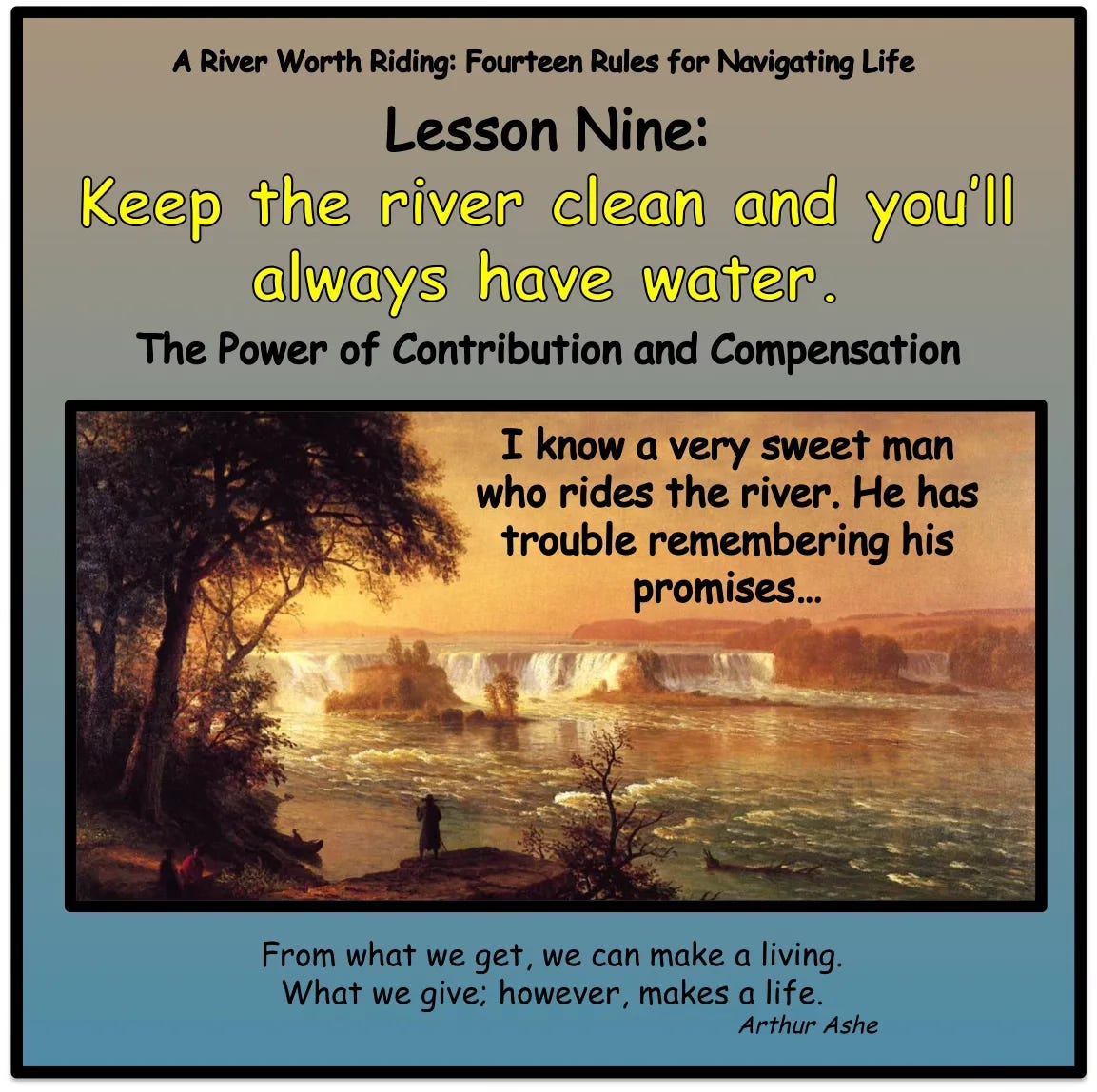
So often, we approach life expecting a “transaction,” I do this, I get that. We think effort should automatically produce reward, fairness should automatically balance out, and chance is either cruel or kind. Life’s real Compensation comes through your contributions—through how you engage, what you notice, and what you take from each experience—rather than through rigid expectations. Outcomes don’t announce themselves as rewards—they always return, but often in a language you’re not expecting. This lesson attempts to teach that language, helping students see patterns, make wiser choices, and avoid frustration when life doesn’t ‘play fair.’
Once again, we begin with a story…
I know of a man who loves to talk about his wife. He loves to tell everybody that his wife makes his life miserable. He loves to say: “You can’t talk to her… She’s got an attitude… She doesn’t make sense.” Every word he utters shines a light on the chasm he’s dug for himself.
You see, this man does not know how to listen, and everyone sees it but him.
He was in my English class. On the first day of class, I announced that a test would be held in two weeks. I even wrote the date of the test on the board and left it there for the entire two weeks.
Each day, I would write questions from that day’s lecture under the test date, and I would tell everyone to study those questions for the test. I even left the page numbers where people could find the answers to the study questions on the board.
I devoted the day before the test to class review. For fifteen minutes, I talked about the test, told people what to study for the test, and even pointed out areas of the test that people usually got wrong. When I dismissed the class, he came up to me and asked, “When is page 51 due?”
“There’s nothing due,” I told him. “You just need to study page 51 for the test.”
“Test?”
“Yes, tomorrow’s test.”
“We have a test?”
I took him gently by the shoulders, turned him to face the board, and pointed to the test announcement that I’d written there. Then I said as slowly and as carefully as I could, “Tomorrow you have a test. You must study those six sections of your book because the answers to the test questions are in those six sections.”
“You’re kidding,” he said, listening for the first time. “We have to know all that by tomorrow?”
This student likes to say that his wife doesn’t make sense. Guidepost Nine suggests that his real problem is not understanding how to make sense of her, and it’s tough to make sense of anyone when you don’t know how to listen.
This student isn’t unusual. He’s just an obvious example. We all find it easier to blame the river for our problems, but the river is just the river and it’s not changing anytime soon. So if you want to fix your problems, start by fixing yourself.
Source: Lynn Marie Sager, A River Worth Riding: Fourteen Rules for Navigating Life, 2005
Whenever the topic of Contribution and Compensation comes up, people immediately start connecting it with concepts like:
Do the right things and the reward will automatically follow.
If I just sow the seeds correctly, the universe will repay me.
Work hard, play by the rules, and good things will happen to me.
Karma will take care of it if I do the right things.
Effort equals reward.
If I put in enough energy or intention, the universe will give me what I want.
Do good, get good; do bad, get bad.
What I put out comes back to me automatically.
Sow the right seeds, follow the rules, and the harvest will take care of itself.
Do any of these sound familiar?
Nothing is inherently wrong with this framing, but for this week, as we honor the Power of Contribution and Compensation, I’d like you to consider what to some of you might be a new framing:
Contribution and Compensation as a Teacher of Wisdom
This idea — that the consequences of our actions can serve as teachers rather than guaranteed rewards — is not new, but it’s often submerged by our transactional culture. Philosophers and educators have long recognized it.
The Stoics wrote about the distinction between what is within our control and what is not, suggesting that life’s challenges are opportunities to develop judgment and character. John Dewey, the American philosopher and educator, emphasized that experience itself is the foundation of learning: what matters is not simply the outcome, but what the experience teaches us and how it informs future action. Across centuries and cultures, this motif recurs: the universe, society, and life itself provide feedback, sometimes harsh, sometimes subtle, that offers wisdom if we are willing to receive it.
To put it simply: Instruction often is the reward.
In this lesson, we will:
Explore the nature of a Transactional versus an Instructional framing as they both relate to Contribution and Compensation.
Notice how your Contributions flow back as Compensation, often in ways you might not immediately recognize.
Discover the lessons hidden in everyday experiences and outcomes.
Examine the stories you tell yourself about effort, fairness, and results.
Learn to read life’s “currents” so that your experiences teach rather than frustrate you.
Explore how the way you engage and pay attention shapes what you receive.
This lesson is part of a larger learning experience, Catching Life’s Currents: A 14-Week Guideposts Journey, offered to paid subscribers, one-on-one learners, and groups. If you would like to learn more, click here.
Keep reading with a 7-day free trial
Subscribe to Navigating a Whackadoodle World to keep reading this post and get 7 days of free access to the full post archives.