
Catching Life’s Currents/Guidepost Twelve: The Power of Communication and Understanding
(Paid Subscribers Only) Ever wonder what people are really saying? In Guidepost Twelve, we explore the six elements of listening beyond words to intentions.
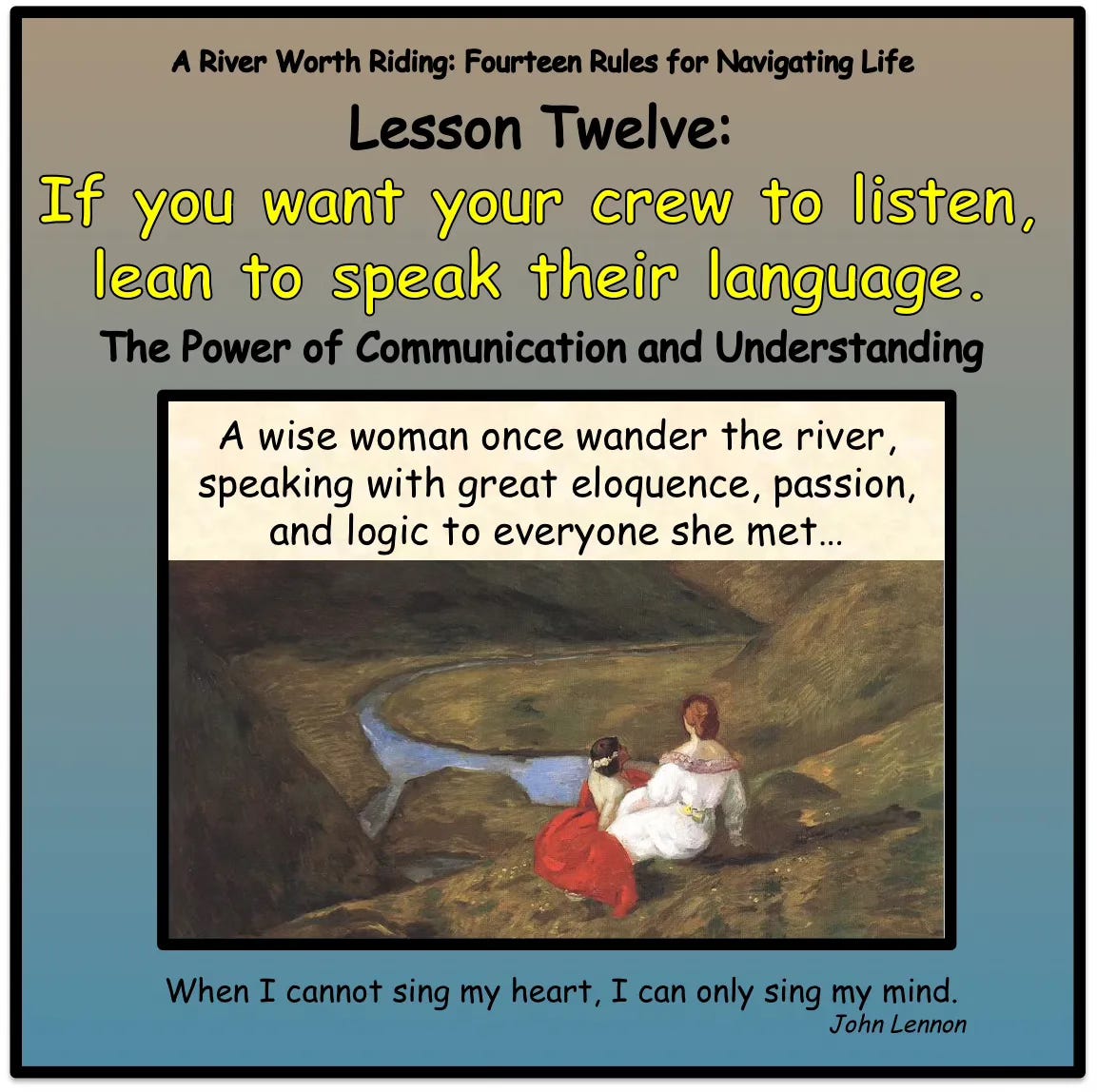
In this lesson, we will examine the six elements of effective listening: Intent, Body Language, Emotional Tone, Reflection, Denotative vs. Connotative Meaning, and Confirm Before Reacting. We’ll discover how to notice what people are really communicating, pay attention to emotions beneath the words, and practice responding in ways that are thoughtful and measured. Through simple exercises, we will observe, reflect, and check for understanding in real conversations or even in media we consume. By the end, we will have a clearer sense of how communication works and practical ways to engage without overreacting, misinterpreting, or losing perspective.
Once again, we begin with a story…
A wise woman once wandered the river, speaking with great eloquence, passion, and logic to everyone she met. She spent nearly a week talking to a waterfall, carefully explaining why a waterfall was an inconvenience to those traveling the river. She pointed out that if the water would just hold itself back a little at the lower end, the level of the river would rise above the fall, and everyone would have a smoother ride. But the water was having such fun fulfilling the laws of gravity that it didn’t really pay attention.
Not perturbed, the kindly wise woman turned her attention to a group of boulders, explaining how their existence caused the rapids—a dangerous place to ride. But if they would simply agree to break themselves into sand, we could all have a smooth beach for swimming. But the boulders just sat there, the way boulders tend to do.
She even spent three weeks trying to convince some bears to keep away from the salmon, pleading with them to stop eating others and consider being nice. But the bears were hungry, and nearly ate her when the salmon stopped running.
This sweet lady has not given up her request for understanding, but she has come to believe that bears are quite rude, that boulders are stupid, and that waterfalls only think about themselves.
However, if you want to communicate with bears, you first have to understand the language the bears respond to. And if you want to communicate with a person, you first have to understand what makes that person tick.
Have you ever met that wise woman? Endlessly talking but seldom getting through? Have you ever been that wise woman?
I know that I have, until I learned that the trick to “getting through” to people begins with understanding the communication process. Communication is not talking, so don’t confuse the two. Just because you’re talking, doesn’t mean people are listening. Just because you have a valuable opinion, doesn’t guarantee that people are open to your words.
Communication is circular. We usually send a message because we’re hoping for a certain response. But too often we don’t consider how our message must be sent to ensure that we get our desired response. We just start talking, and then we get frustrated whenever people don’t react as we like. We fail to say what we mean, then we fight over whatever we said. We can listen to people so long as we agree with them, but the moment we disagree, we stop listening and start defending our perspective.
Communication is not about agreeing. It’s about understanding.
The word communication is derived from the Latin word for “common.” In other words, communication is the ability to bring separate minds together in a common understanding. Whenever we sincerely communicate with people, we create rapport.
What is rapport? The dictionary defines rapport as “a connection between people… an affinity… a harmonious or sympathetic relationship.” But too often, people use communication to prove a point, not to create rapport.
And do you remember our definition of insanity: expecting to solve any problems from the same level of thinking as you were when you created it? Well, if your relationships are unsatisfying, then perhaps the cause of your dissatisfaction flows from your inability to communicate effectively.
Poor communication is the primary reason relationships sour. Poor communication is the main reason people fail to get what they want. Poor communication is the cause of many arguments. And poor communication is at the root of most folly. If you attempt to communicate with people but don’t create rapport with them, then perhaps you need to find some new ways to communicate.
Communication is a revolving process. You send a message, someone interprets your message and sends back a response. You interpret their response and send another message, and so the cycle continues. But at any point within that cycle, communication can hit a barrier and break down.
Communication barriers are many: noise, interruptions, prejudices, assumptions, vague meanings, emotions, attitude, misunderstandings, technobabble, unclear thoughts, defensiveness, criticism, and boredom.
You need to notice when and why that cycle breaks down if you want to keep that cycle moving. So let’s take a look at the rules of effective communication and see how you’ve been doing.
The primary rule of communication simply states that without understanding, communication is impossible.
But if that’s the rule, then how do we reach an understanding?
I had a student come up to me once and ask how he could get people to understand him. I began to explain that people come to conversations from different levels and perspectives.
“I already know all that,” he interrupted, “but how do I do it?”
“Do what?”
“Get them to my level?”
That took me aback. “What do you think I was about to suggest?” I asked.
“That I have to bring people to my level?”
“Nope,” I shook my head vigorously. “In fact, that’s the exact opposite of what I was about to suggest. You can’t expect people to come to your level. You have to go to them. People can’t understand you unless you speak their language, and you can’t speak someone’s language unless you actually learn it.”
“So how do I do that?” he asked.
“The same way you learned English,” I replied, “by listening to people speak.”
Unfortunately, most people are so busy listening to their own thoughts that they seldom have room in their minds for anyone else’s. But when you don’t listen to people, communication is impossible. After all, why should people listen to you if you don’t listen to them? And until you understand what people want, why would you assume that you have the information they need? Unless you understand people, you have no hope of communicating with them.
So let’s break down the communication cycle, and discover how we can reach rapport and a common understanding more often.
In this lesson, we will:
Examine the communication cycle, paying particular attention to the moments it tends to break down.
Consider the impact of communication barriers, and what it takes to navigate through them.
Study and then practice the six elements of effective communication.
Considering Intent
Reading Body Language
Hearing Emotional Tone
Reflecting Perspective
Determining Connotative vs. Denotative Meanings
Confirming Before Responding
This lesson is part of a larger learning experience, Catching Life’s Currents: A 14-Week Guideposts Journey, offered to paid subscribers, as well as individual and group clients. If you would like to learn more, click here.
Keep reading with a 7-day free trial
Subscribe to Navigating a Whackadoodle World to keep reading this post and get 7 days of free access to the full post archives.