
Catching Life’s Currents/Guidepost Seven: The Power of Process and Growth
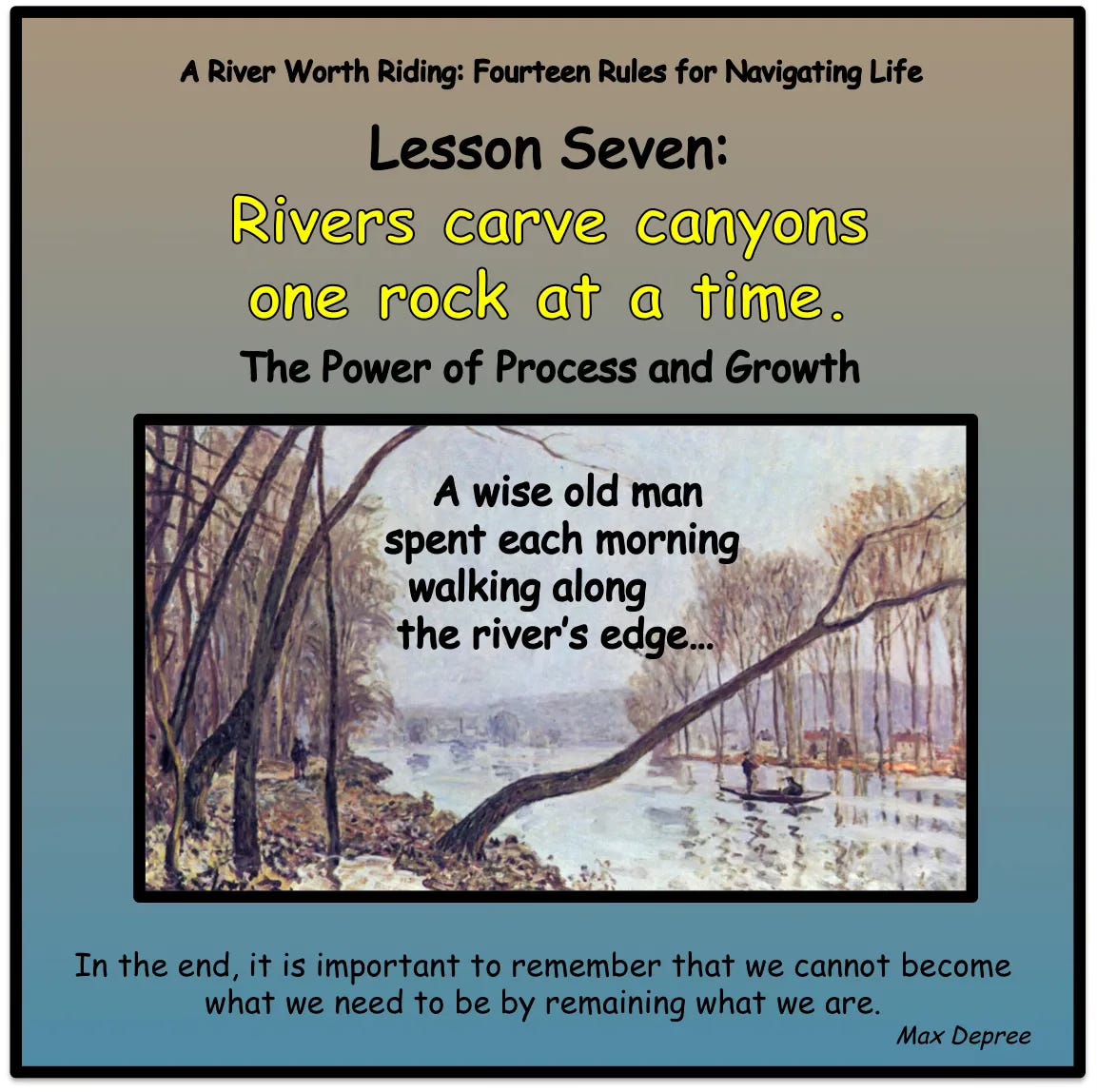
(Paid Subscribers Only) “In the end, it is important to remember that we cannot become what we need to be by remaining who we are.” — Max DePree, Leadership is an Art (1987)

This week we dive into Process and Growth, including why process matters, how tipping points sneak up on you, and why our brain’s natural negative bias can slow progress. We’ll discuss problem solving, delegating, boundary setting, truth detecting, image modifying, and procrastination busting—not to fix everything at once, but to pick one challenge at a time, give it one week’s strict attention, and leaving all the others to their ordinary chance. By the end, you’ll have a practical set of tools to stretch your comfort zone, test your assumptions, and watch small wins turn into real growth.
Let’s once again begin our lesson with a story…
Some of you might have heard this story before, or a variation of it:
A wise old man spent each morning walking along the river's edge. Every few feet he would stoop down, scoop up some water, and then softly pour the contents of his hand into a rock near the shore. Curious at the old man's odd behavior, a youth rowed over to the man one day and asked what he was doing.
“I'm saving lives,” the old man said. “The wind blows many things into the river. Unless they can dry their wings, they will die.”
“This river goes on forever,” the young man laughed. “There must be a thousand insects falling into it every time you catch a breath. You can't think that you're making a difference.”
In answer, the old man simply stooped down and scooped a small honeybee into his hand. Gently, he placed the honeybee on a warm, dry stone.
“I just made a difference to that life, didn't I?”
Source: A River Worth Riding: Fourteen Rules for Navigating Life, Lynn Marie Sager, 2005
The only significant differences that human beings have ever made on this planet have always begun with small, consistent efforts of an individual who is willing to work as long as it takes to make that difference.
If you don't believe me, then ask any overnight success how long they've worked on becoming successful. Ask anyone with a fulfilling relationship how much energy and time went into building that relationship. Ask anyone who has come to terms with who they are exactly how long it took to cultivate their sense of self-worth. Ask anyone who has achieved their dream how long they worked to accomplish that dream.
We all know that success takes time. We all know that success isn't easy. But if that's true, then why do so many people give up before they've even begun? Why do so many people look at a challenge, begin to feel overwhelmed, and immediately say that the challenge is too hard?
Perhaps people have forgotten the Power of Process.
I know that for me, whenever I forget to follow a process, or skip a step in that process, my life suffers—even if it’s just in small ways.
For example, if I start cooking while the dishes are still drying in my drying rack, then by the end of the night, I will have a disgusting, messy kitchen. Still things in the drying rack, but now a whole bunch of dishes are overflowing in the sink, on the drainboard, and covering my oven.
The chances are, after dinner, I’m going to look at it and go, never mind, and I’ll wake up to the same mess, which I had better clean up, or risk an even bigger mess.
However, if I don’t skip a very important point in the process—which is to put away the dry dishes and empty the dry dish rack before I start cooking dinner—then I am much more likely to wash each dish as soon as I’m done cooking with it. I almost naturally clean as I go, and by the time I’m done cooking, my kitchen is already pretty clean—and I can enjoy a restful dinner.
What makes the difference? That simple little step—don’t start cooking if the dish rack is full—a single step in the “preparing dinner” process that I hadn’t even noticed until I looked for it. It’s basically: empty rack → I clean as I go → no pileup → no overwhelm → following-through rather than avoiding. But the process only works if I don’t skip the first step.
Process is everywhere, but we don’t always acknowledge it. However, when we unintentionally, or intentionally, skip steps in a process, we often end up with a life as messy as my kitchen.
I suppose it’s understandable, living in today’s quick-fix, instant-gratification culture, where one new product or purchase is expected to change everything overnight. I’m sorry, but real growth doesn’t respond well to quick fixes, cure-alls, or hacks. Real growth and change respond to nudges, reminders, and small everyday choices.
Every river knows that even mountains can be moved one pebble at a time. Sure, we hear about the mudslides and avalanches—the sudden, dramatic changes—but those moments are only the visible result. It’s the constant drip, drip that quietly makes them possible.
“In the end, it is important to remember that we cannot become what we need to be by remaining who we are.” — Max DePree, Leadership is an Art (1987)
And in order to become what we need to be, we need to honor the Powers of Process and Growth. Small steps matter. Small steps lead to growth.
In this lesson, we will:
Learn how small, consistent actions compound over time, and why most things in life grow exponentially—including success, frustration, and curiosity.
Discover how to apply the Pareto Principle (80/20 rule) to focus on the small percentage of actions that produce the majority of results.
Consider how individualized processes can be adjusted to accommodate different temperaments and learning styles.
Examine practical processes for raising self-esteem, including understanding your self-image, self-ideal, and self-esteem, and taking one small mastered action each day to bridge the gap.
Review the decision-making process, delegating process, and problem-solving process, and see which steps you’ve been skipping and what skipping them costs in options, clarity, and results.
Learn a step-by-step approach to reducing procrastination, by identifying its causes and matching them with tools that actually work.
Practice applying these processes in your own daily life, so you can start seeing measurable growth and build habits that compound over time.
This lesson is part of a larger learning experience, Catching Life’s Currents: A 14-Week Guideposts Journey, offered to paid subscribers, one-on-one learners, and groups. If you would like to learn more, click here.
Keep reading with a 7-day free trial
Subscribe to Navigating a Whackadoodle World to keep reading this post and get 7 days of free access to the full post archives.