
Catching Life’s Currents/Guidepost Five: The Power of Strategy
(Paid Subscribers Only) Meet the three heads of Strategy, discover why they clash, and how you can harness their power for a smoother and more fullfilling ride.

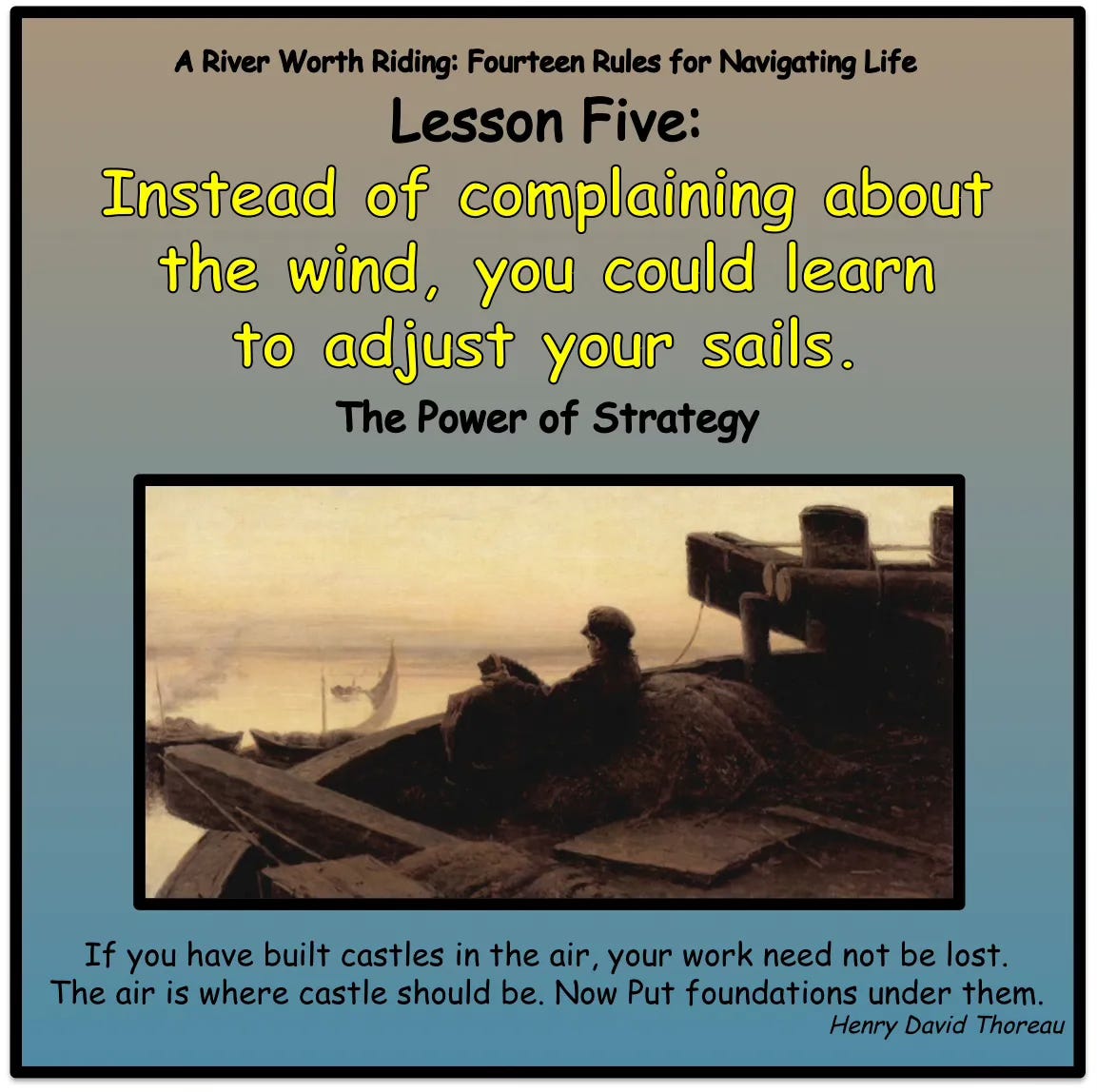
Most people think strategy is merely about to-do lists or plans. But, it’s much more. It’s about how your mind works: balancing creativity, discipline, and follow-through. In this lesson, you’ll meet the parts of your mind that make strategy possible and learn how to get them working together so your ideas actually take flight.
Why Strategy is so Misunderstood…
Strategy isn’t just a plan—it’s a conversation happening inside your mind. Let’s begin this lesson by listening in to one such conversation, as recorded in my third book:
Navigating Life Through Turbulent Tides
Fifteen years after publishing her first book, a retired self-help expert is confronted by the very methods she once taught. When her answers fall short, the methods take over—telling their own story in a unique, insightful, and often humorous guide to getting the most out of life.
What follows is an excerpt from Strategy’s story…
I headed to the bus stop in the pouring rain.
The three-headed brothers were already seated when I boarded the bus. They were in my preferred corner. The right-head was gazing happily out the window. The center-head looked like he might have been asleep. The left-head was sending me his best scowl. I heaved a sigh and headed toward them.
“Greetings,” I said when I got close.
Left-head raised an eyebrow. “Salutations,” he replied. “Sorry we took your spot, but somebody over there insisted on being next to the window.” His head jerk right when he said the word “somebody,” and his eyes shot daggers at the offending head.
“No problem,” I said, lying. “I’ll just sit in the middle. You know, I can’t just keep thinking of you as left-head, center-head, and right-head. What should I call you?” I asked, as I struggled to get myself settled.
“How about Stra, Te, and Gy,” suggested the right-headed brain, still staring out the window.
The left-head’s scowl deepened. “That’s a ridiculous suggestion.”
The right-head shrugged. “Maybe past, present, and future,” he called out again.
“That’s no better than left-head, right-head,” grumbled the left-head.
I shifted uncomfortably. “Maybe you could explain who you are and we could go from there,” I offered.
The left-head nodded. “Well, the guy on the right is in charge of your right brain. He’s basically your creativity. I’m in charge of your left brain, so I do all the planning. The brainless guy in the middle here — well, he’s essentially all of your habits. Together, we make strategy possible.”
“Hey,” interjected the right-head. “I know. Maybe she should call me Creativity.”
“No, no,” the left-head objected. “Obviously, she ought to call you the Explorer, me the Navigator, and the numbnut here Workhorse. After all, that’s what she called us in her book, and we don’t want anybody to get confused.”
“Boring,” sang the Explorer, pulling on the word boring, then turned his attention back to the window.
“Consistent,” insisted the Navigator. Then turning to me, he added, “Is that okay with you?”
“Sure, it’s fine for me if it’s fine for you.”
“Good. Now to business,” he said, clapping together the two hands that all of them seem to share. “Why have you been ignoring us?”
“I haven’t been ignoring you. I just haven’t been making use of you.”
“Same difference,” he informed me.
“Well, you guys are so complicated. I get tired even thinking about you.”
“That’s because you complicate us in your book by trying to fit everything that you have heard about us in,” he said, shaking his head. “You included us in your book because other people told you how important strategy is, but you’ve never really taken advantage of what you know.”
“Fine. Okay,” I pleaded guilty. “What do you want me to do about it?”
“Give us a chance,” he said, emphasizing each word separately.
“I will. I want to,” I assured him. “How do you suggest I begin?”
With that, Explorer turned to face me. “Well, I suggest we begin by reintroducing ourselves,” he told me, “each in our own words. I think that I’ll begin.” He cleared his throat, raised his chin, and proclaimed, “I am every crazy, foolish, constructive, silly, funny, practical, impractical, and inspired idea that you will ever have. I wander through the mirrored labyrinths of your brain, seeking to discover connections and possibilities. I am not bounded by the past or even the now. I live in the future, where I can build castles in the air.”
“Do you always talk like that?” I asked.
“So what?”
“So flowery?”
He paused to consider. “Around you, I do. Around other people, not so much. Each mind is different, but regardless of who I’m with at the moment, I am the part of the mind that likes to open things up and look inside to see what makes things tick.”
“Ask him what he’s good for,” smirked the Navigator.
“Well, without me,” the Explorer turned to speak directly to the Navigator, “you would be stuck in the past, endlessly pushing around papers that you’re too afraid to toss. Read about everything and everybody. You remember what Einstein said about me?”
“Oh, don’t go pulling that Einstein thing on me again,” snapped the Navigator.
The Explorer ignored him and suddenly began speaking as to a crowd. “Einstein said, ‘Imagination is more important than knowledge.’ That’s me he was talking about.” He pounded a hand on his chest. “And don’t forget what Einstein said about you: ‘Common sense is nothing but a collection of prejudices that people acquire by the age of 18.’ That was you he was talking about.”
With that, the Explorer went back to staring out the window. Somewhere in the middle of it all, Workhorse woke up, calmly rubbed some hand sanitizer through their shared hands, and then fell back asleep.
“I’ve never been able to verify those quotes,” the Navigator muttered under his breath.
“Whose fault is that?” sneered the Explorer without turning.
The Navigator looked at me, then looked away. “Sorry about that,” he began.
“Sorry about that?” mimicked the Explorer to the window. “Why are you always so worried about what other people think?”
“Experience,” hissed the Navigator. “Something you don’t seem to care about or respect. Why, without me, you’d be running around chasing your own tail. I’m the one who organizes budgets, plans, sorts. I swear that without me, you would get nowhere fast. You would be up there in those air castles of yours, attempting to eat clouds. How’d you like it then?”
He heaved a great sigh and shifted to face me. “As I was saying, I apologize for our conduct, but at least now you know what we become like when we are left to our own without clear guidance. We need you as much as you need us.”
“Are you telling me that this kind of fighting is going on inside my head?”
“More than you know.”
“I’m almost afraid to ask, but what does Workhorse do?” I said, nodding toward him.
Workhorse lifted his head as I mentioned his name. “Me? I do whatever I’ve been taught,” he said, and went back to sleep.
“And it’s not just you,” sighed the Navigator. “Without direction, nearly every brain struggles like this.”
Excerpt: My Interview with Strategy, Navigating Life Through Turbulent Tides, Lynn Marie Sager (2020)
Just like the brothers in this story, your mind has distinct areas of operation—each designed to do a specific job. What we commonly know as the right brain, are those parts of your mind associated with play, creativity, innovation, and inspiration. What we commonly refer to as the left brain is associated with logic, structure, planning, and strategy. And that third brother? Well… I like to think of him as our cellular memory—our habits. Those things we do automatically and without any thought.
My point?
When these brothers aren’t talking to each other, ideas stall, decisions falter, and even simple plans feel like a tangled mess. Unfortunately, most of us are never taught how to get the brothers working together. They end-up at odds with each other, trapping us in procrastination, indecision, second-guessing, and self-doubt.
The trick of strategy lies in getting your “brothers” to understand and respect the work that each has to offer. When you do, you will begin to think strategically.
In this lesson, we will:
Explore how cultures prize logic, stability, and structure, over creativity, discovery, and play.
Examine how indecision, writer’s block, procrastination, and other common blocks all share a common root cause.
Reveal the crucial step often skipped in a process—and what it takes to restore it.
Provide a road map for bringing the three brothers in your mind together, so you can see what it really means to live strategically… and by strategically, I mean jam packed with joy.
Unpack what it takes to train, and even retrain, a habit.
Invest a little time in crafting a personal commission
This lesson is part of a larger learning experience, Catching Life’s Currents: A 14-Week Guideposts Journey, offered to paid subscribers, one-on-one learners, and groups. If you would like to learn more, click here.
Keep reading with a 7-day free trial
Subscribe to Navigating a Whackadoodle World to keep reading this post and get 7 days of free access to the full post archives.